Spirit and sensuality
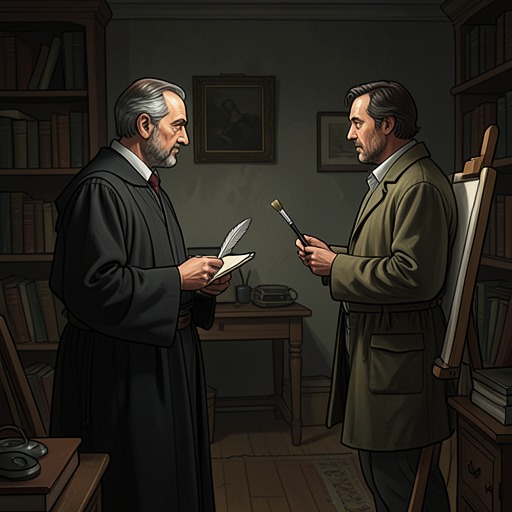
Narcissus and GoldmundSpirit and sensuality describe the conflict between the mind’s effort to rise above transience and the senses’ immersion in life, as well as the possibility that these paths may be complementary rather than mutually exclusive. Goldmund experiences their division as a personal and philosophical crisis: he longs to live fully without surrendering the power to create, and to create without drying up his capacity for life. His conversations with Narcissus eventually give that longing a language, while their friendship turns opposition into reciprocal recognition.
The divided claims of life
For Goldmund, existence appears to demand a choice. One may live through the senses, drawing bliss from the primitive mother’s breast, but such immersion offers no protection from death: life flourishes briefly and then decays. Or one may defend against transience by dedicating oneself to work and an enduring monument. That defense can preserve something beyond an individual life, yet it risks making the worker an instrument of permanence, cut off from freedom and sensual pleasure. Goldmund sees this sacrifice exemplified by Master Niklaus, whose devotion to lasting work seems to have come at the cost of life’s scope.
The dilemma is not merely a contrast between two temperaments. Goldmund perceives duality running through creation and human existence: man and woman, wanderer and settled burgher, thinker and feeling person, freedom and order, instinct and mind. Each desirable condition appears to exact the loss of another. He wonders whether the division reflects an incompleteness in creation or serves some purpose, and whether human longing might be the source not only of pain but also of what is beautiful and holy. In his account, the very lack that frustrates fulfillment may also give rise to human creation.
Goldmund’s question is whether the alternatives can be joined: to create without sacrificing the senses, and to live without renouncing the nobility of creation. He can imagine faithful or settled people who preserve sensuality and freedom, but has not encountered anyone who seems to have reconciled those demands. The tension therefore remains more than an abstract proposition; it is the unresolved measure by which he examines the life he has led.
Sensual life, death, and art
In conversation with Narcissus, Goldmund describes the recurrent movement between the horror of death and the escape of lust. Narcissus recognizes the pattern as an unusually sharp version of a common human experience and asks whether Goldmund has tried another way. Goldmund answers with art, which offered a response to transience without simply denying it.
His turn toward sculpture began after years of wandering, when a wooden Madonna in a cloister church moved him enough to seek out its maker. Goldmund found the famous sculptor and worked as his apprentice for several years. He understood artistic work as a means of giving duration to mortal experience: works of art can outlast many lives and preserve a world of images and relics beyond the fleeting moment, even though they too may eventually burn, crumble, or be destroyed. Art thus approaches eternity rather than achieving it; its consolation lies in making the transitory last longer.
Goldmund’s account goes beyond the idea of sculpture as a faithful record of a person who once lived. He explains that a work’s basic image is not flesh and blood, even if a living figure may inspire it. The image has its home in the artist’s soul and can be made visible in matter. Narcissus identifies this account with the philosophical idea: before a figure takes material form, it exists as an image in the creative mind. Goldmund’s art consequently joins sensory attention to an inward power of form. It does not simply choose between mortal matter and enduring thought; it gives an inward image a body in which it can be seen.
Narcissus and Goldmund’s reciprocal recognition
Narcissus interprets Goldmund’s artistic account as evidence that creative mind can offer a way through the confusion of sense and despair. He has addressed himself to that capacity in Goldmund since Goldmund came to him as a boy, but now distinguishes it from the thinker’s mind: Goldmund’s is the mind of an artist. The recognition changes the meaning of their friendship. Goldmund’s life briefly seems to resolve into three stages—dependence on Narcissus and awakening, freedom and wandering, then return and reflection, the beginning of maturity and harvest. He can return as Narcissus’s guest without the humiliation of dependence, because Narcissus has acknowledged the creative power that is his own.
Their later exchange shows that this recognition works in both directions. Narcissus confesses that he once regarded art as inferior to thinking and science. Because he understood mind as a path toward the eternal and matter as a bond to the transitory, he had assumed that one should turn away from the senses. His respect for art had been only conventional; inwardly he was arrogant toward it. Watching Goldmund work teaches him that there are multiple paths to knowledge, and that the intellectual path is neither the only one nor necessarily the best. Narcissus remains committed to his own way, but can now recognize how deeply Goldmund has grasped the secret of being through the senses.
Narcissus describes the difference between them as a difference in what each attends to. Thinking converts particular things into abstractions and looks away from sensory reality in an attempt to build a purely spiritual world. Goldmund instead takes mortal things to heart and reveals meaning through their mortality. By giving himself to the world and re-creating it, he raises creation toward the eternal. In Narcissus’s formulation, thinkers seek God by drawing away the world’s covering, while Goldmund approaches God by loving and recreating what has been made. Both endeavors are human and imperfect, but Narcissus judges art the more innocent path.
Complementarity without easy reconciliation
Their exchange does not erase the difference between them. Goldmund envies Narcissus’s calm, detachment, and apparent peace, believing that thinkers and theologians better resist despair. Narcissus corrects this impression: the peace Goldmund sees is not an unchanging possession but something that must be won again each day. His life as Abbot and his practice in the prayer cell involve struggles and sacrifices that Goldmund does not see. The thinker’s apparent composure is therefore not freedom from conflict, just as the artist’s immersion in sensation is not a complete escape from despair.
The novel’s treatment of spirit and sensuality rests on this mutual limit. Goldmund’s art cannot make mortal life literally permanent, and Narcissus’s intellectual discipline does not abolish struggle. Yet each path discloses something the other risks overlooking: thought seeks enduring meaning through abstraction, while art finds meaning by remaining faithful to embodied, particular life. Their friendship matures not through one man’s conversion to the other’s way, but through a more equal understanding of what each can know and create. The unresolved division remains real; what changes is their ability to recognize its two paths as human endeavors rather than treating one as the sole measure of the other.